
Bishop Joanne thanks the public sector across Suffolk
Bishop Joanne writes for the East Anglian Daily Press September 2026

St Margaret of Antioch Leiston | 6 September 2026
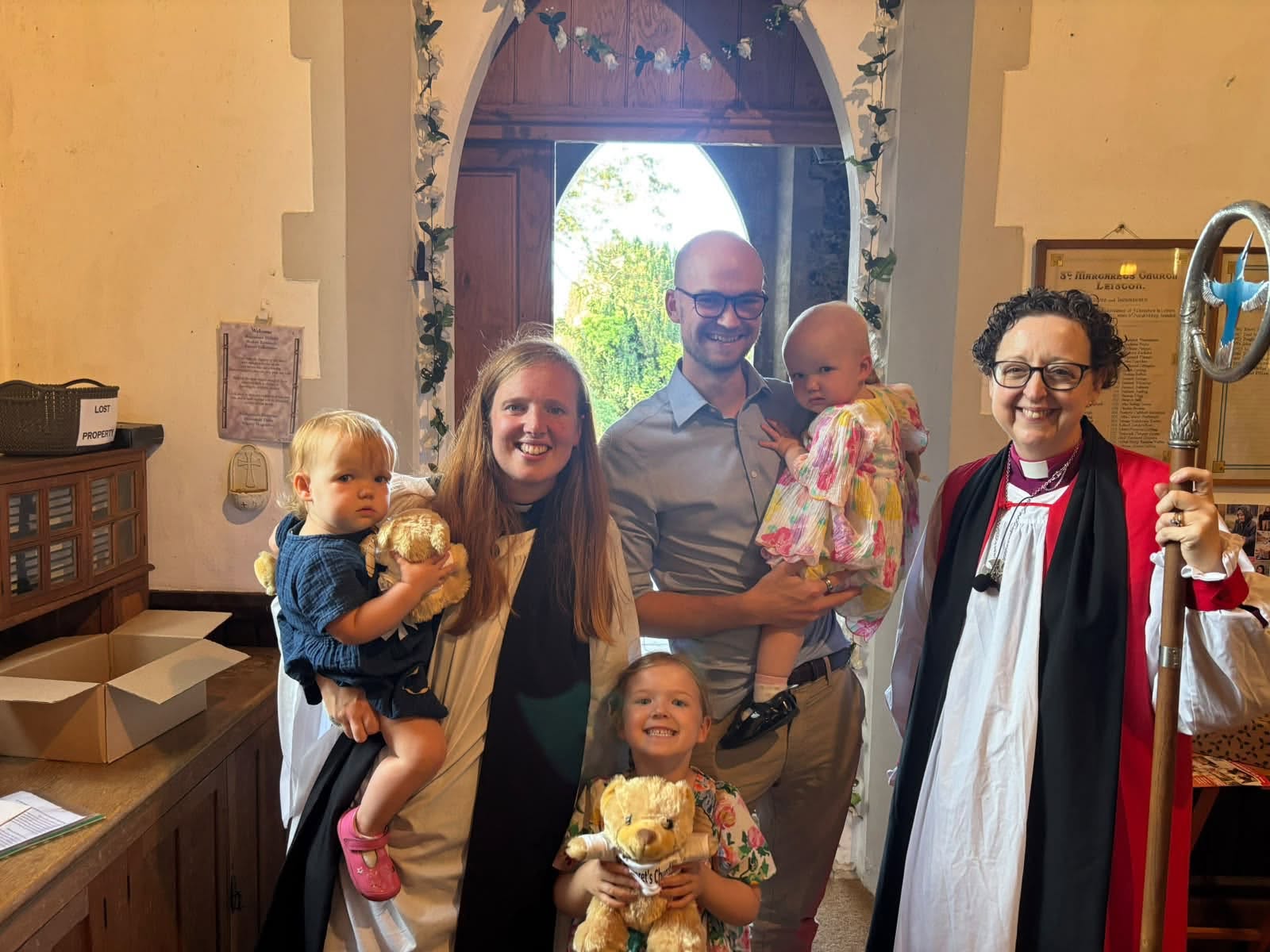
The licencing of Revd Cailtin Harland as curate-in-charge
St Margaret of Antioch Leiston
6 September 2026
Joanne Grenfell
Matthew 13.31-34
I wonder if you have heard about the father talking to his young daughter. She is holding a small acorn in her hand as they are standing under a very large oak tree. She is looking very sceptical. ‘You are telling me this acorn is this oak tree?’ ‘Well yes’, he says, ‘in a nutshell.’[i]
I guess that parables are a bit similar. Their stories point to ideas, behaviours, and seeds of life that can take root in us and grow into the oak trees of values, character, and commitment that shape our lives.
Two of the parables that Jesus told, acorns of God’s wisdom, as described in Matthew’s gospel, have been planted again by Caitlin to speak to us here today; seeds of new beginnings for Leiston and Sizewell, we can pray that they might shape our life of faith here as she becomes your new minister.
First Jesus speaks of the mustard seed, the beginnings of a plant that isn’t grand or strong. Instead, it’s a persistent weed-like little plant that, in first-century Palestine, was known for growing anywhere and everywhere.
If Jesus had wanted to pick a tree to convey that message of solidity, security, or magnificence, he’d have spoken about a cedar tree or perhaps an oak tree – both of which are mentioned approvingly in the Old Testament for their strength and size.
But he didn’t: he chose instead something ordinary and commonplace that invades everything, that messes things up, that can’t be defeated or eradicated, and that changes life in the garden for everyone.
Second, he speaks of leaven, or yeast. It’s an equally odd choice of image. A mouldy piece of dough, put into enough flour to make bread for over a 100 people, leaven was usually used as an image of corruption or contamination (as in the Letter to the Corinthians).
But again, whilst it is secret, furtive, and slightly disreputable, it also changes everything. And it disappears, losing its own identity, as it brings life to the ingredients with which it is mixed.
I first met Caitlin during the Covid pandemic. I used to be her Bishop – and I am so pleased that I will be again in Suffolk!
In May 2020, Caitlin was hosting a Zoom call as part of an East London community organizing campaign called Don’t Freeze Iceland Out. I was glad to support their work, and so I was invited to the online meeting.
Our aim was to help families struggling with the injustice of food insecurity, when Shadwell’s only realistically accessible supermarket – Iceland – wasn’t included in the government voucher scheme intended to continue to provide free school meals when schools were closed because of the crisis.
Community organizing is great, not just because of what it achieves, but because of how it goes about it. It encourages the whole community to pay attention to matters of justice. As it works, it develops and empowers communities to see the assets that they already have within them and to use them for good.
As with the mustard in Jesus’ parable, community organizing sows the seeds of leadership that comes from and gets into the places that others can’t reach. To do so, it must be properly embedded, never sitting above issues, but working from ground level.
And, like the woman in the parable’s portion of yeast, community organizing also quietly adds to the mixing bowl leadership that builds up other people and then disappears quietly out of the way leaving a stronger community.
I believe that such work speaks of the kingdom of God. It sows ideas, behaviours, and the very seeds of life that can take root and grow into the oak trees of values, character, and commitment that shape us not for our own ends but for the common good.
I wonder how we might hope and pray for the church in Leiston to be seed and to grow the Kingdom of God – persistently, unexpectedly, annoyingly, selflessly.
And, in a place where the local community is rather dwarfed by its power station neighbour, even as many welcome the jobs and opportunities that Sizewell C brings, I wonder how we might also take heart in knowing the power and contribution of such tiny elements as a mustard seed and a measure of yeast?
There is much to admire in the incredible science behind nuclear power, and in the organization that sets out to create a safe system for bringing clean energy to millions. Perhaps we could even say that it points to the great source of energy in the universe – our Creator God – in ways that we likely didn’t have the vocabulary to imagine or express before nuclear fission was discovered.
But, at the same time as inducing awe in us, it must also raise some questions. How can nuclear science build up our shared lives, bringing benefit equally to many? Or how might it be misused, bringing destruction?
And what ways of thinking does it develop in us? Rational, scientific, closed system ways of thinking are needed to create a laser like focus on the energy production that is essential for or survival. But if we are fully to inhabit this earth that God has given us, there are other kinds of energy that we will need to pay attention to as well – including the energy that flows through interconnected, interdependent, human communities.
Although science can tell us the what and the how of creating nuclear energy that can power Suffolk and the UK, it can’t tell us the why: why you are you and I am me, why life and energy dwell among us, or why we are always connected, charged, and changed by our relationship with each other.
The life of faith – life lived in the knowledge and love of God, through Jesus, in the power of the Holy Spirit – shows us how to notice the different and deeper aspects of being human. It teaches us to see the diversity and abundance of creation. In worship, it trains us to wonder at its beauty, depth, and playfulness.
The life of faith points us to love – a dimension that no equation can express or solve; love, the overwhelming, unstoppable, self-giving surge of love that comes in the person of Jesus Christ from the very heart of God. This is love that lights up the whole world.
I invite you, as you begin this journey of ministry with Caitlin (and Joel, and their daughters) to be confident that, in faith, you have something worth saying about God and about love – something that can be as transformative for your community in Leiston and Sizewell as a mustard seed or a measure of yeast.
Take the stories of faith that you’ve inherited, including the parables which we’ve been planting and watering here today.
Look together for the deeper meanings, the tendrils of intuition, the nutshells of wisdom that point to God. Attend to each other as human beings, created, known, and loved by God. Build up this local community so that every person can step into fullness of life.
Care for creation: pay attention to the fire-damaged woodlands on Dunwich Heath, uncover what remains of their deep root systems, and tend carefully the beautiful, fragile interconnectedness of the whole local habitat.
And the birds of the air will come and make nests in the branches that will grow from this church and community.
You are telling me this acorn is this oak tree? Well yes, in a nutshell.
31 He put before them another parable: “The kingdom of heaven is like a mustard seed that someone took and sowed in his field; 32 it is the smallest of all the seeds, but when it has grown it is the greatest of shrubs and becomes a tree, so that the birds of the air come and make nests in its branches.”
33 He told them another parable: “The kingdom of heaven is like yeast that a woman took and mixed in with[a] three measures of flour until all of it was leavened.”
34 Jesus told the crowds all these things in parables; without a parable he told them nothing. (Matthew 13.31-34)
You shall go out with joy
and be led forth with peace,
and the mountains and the hills
shall break forth before you.
There’ll be shouts of joy,
and the trees of the field
shall clap, shall clap their hands,
and the trees of the field shall clap their hands,
and the trees of the field shall clap their hands,
and the trees of the field shall clap their hands,
and you’ll go out with joy.
STUART DAUERMANN (b. 1944)
Thanks to David Runcorn for the story: https://davidruncorn.com/drwp/mustard-seed-faith-being-a-weed-for-jesus/
Bishop Joanne writes for the East Anglian Daily Press September 2026
14 September 2026
3 September 2026
The Rt Revd Dr Joanne Woolway Grenfell, Bishop of St Edmundsbury and Ipswich and a House of Lords member, said it was difficult to…
During August, many people will be looking forward to a holiday, a day trip, or simply a few days with…
Bishop Joanne writes… Earlier this month, I ate so many scones recently that I was “scone-fident” that I would soon look…
Following the arrest of 12 people with the possible threat to the UK Ijtima event at Shrubland Hall, in Barham. The…
Bishop Joanne writes… I suffer from quite bad dizzy vertigo. It’s not actually a very serious condition and it…
As Bishop of St Edmundsbury and Ipswich, I have the privilege of serving alongside clergy and congregations in Anglican parishes…
Sometimes, we need to listen to our wake-up calls. I don’t mean the kind of wake-up call that we arrange…