
St Edmund King and Martyr
Sunday 15 November | Let us bear the light of Christ in Suffolk.

As we bring Suffolk’s harvest home today, as followers of Jesus in this place, may we notice and be thankful.
4 October 2026
County Harvest Festival
St Edmundsbury Cathedral
Joanne Grenfell
Deuteronomy 8.7-18; Luke 12.16-30
We have had an abundance of courgettes in our garden this year, despite there being so little rainfall. Every year, we never quite manage to spot and pick them when they are small; and then we find whopping great marrows hiding under the leaves and we have to come up with even more recipes to accommodate them.
We have fried them, with smoked paprika; spiralized them to eat like spaghetti; made them into a creamy soup with lemon and nutmeg.
The low point, though, was trying to disguise them into fruity, oaty cookies, when our children were small. I thought that I’d peeled all the green skin off so the grated pieces wouldn’t be noticeable, but I clearly hadn’t done a good enough job. They tasted delicious, but they were spat out in disgust. “Is it any wonder I have trust issues!” said our eldest, who I don’t think actually has trust issues at all, but he had heard the line on an American sitcom and decided that now was his moment to use it.
When I was thinking ahead to this Harvest festival, I dared to suggest to my husband that I might reflect on the super abundance of God’s love in relation to our courgettes. “Our courgettes!” he spluttered. “Who planted them, who tends them, who waters them, who picks them?” It was a fair point.
But one thing is clear, whoever cultivated, planted, and tended these hardy green veg, which seem to hang on to abundance even in the middle of a drought, they are still producing a glut well into October. I notice, and I am thankful.
I know that it has not been so for most of Suffolk’s crops this summer. With no effective rainfall for 11 weeks from mid-March, our harvest had to take place early, yields were low, and the pressure on water reserves has been immense. I understand that the winter will be hard with hay, silage, and straw in short supply. Food and feed prices are likely to go up.
I think you already know that I am not a farmer. You now know also know that I am not a gardener. You might have concluded that I am not a very good cook either. But, like most of the rest of this country. I am dependent on our farmers and fishermen: for my fruit and vegetables, my meat and fish, my grain, and my dairy products. I notice, and I am thankful.
And, in a year when low rainfall, hot weather, fire, and all sorts of political decisions made far from Suffolk have made the work of all our Suffolk producers even more difficult than in other years, I want to say thank you. Thank you for feeding the county. Thank you for feeding the nation. Thank you for providing my daily bread. I notice, and I am thankful.
In Deuteronomy, Moses not only restates God’s laws to his people, he also encourages them to notice and to be thankful. God has remained faithful to them all through their enslavement and their exodus and has brought them to a good land with flowing streams, rich harvests, and abundant resources. After their testing, they are to resist entitlement and learn to be humbler and more dependent on God.
There are words of wisdom for us here too. Not words that deny past hardship or diminish what is scarce and tough at the moment. But words that invite us still to notice and be thankful.
I notice how farming has developed in our county. I had the pleasure of attending the tractor run at the Euston Estate back in May. I tell you, blessing tractors wasn’t in the job description when I agreed to become your bishop. But I am so very glad to have discovered that it is. I learned all about the history of Massey Ferguson tractors, even down to their variations in paint colour and revolutionary three-point hitch system, which safely locks implements to the tractor and makes all sorts of other modern machinery possible.
The extraordinary ingenuity of those who developed this technology is truly something to be thankful for. So, as I blessed 50 or so tractors on that windswept May morning, I noticed and was thankful.
Also now firmly, if unexpectedly, in the bishop’s role description, is the Suffolk Agricultural Association’s Schools Event at Trinity Park. Well, there were pigs and lamas and goats – and several thousand school children having a whale of a time. For many, it was a surprise to learn where sausages come from and how they are made. Sampling a few sizzling bangers undoubtedly helped all our learning. I was certainly thankful!
But somehow, in today’s world, we seem to have become separated from real food production to the point where many children and some adults can’t imagine what’s beyond the supermarket or the fast-food restaurant.
I hope that more young people can be encouraged to make the connections between our Suffolk landscape and the food on their dinner tables. And, as with the Israelites in Deuteronomy, I hope that we can all notice where God’s provision has been present in our history and be thankful where we still see it all around us today.
Noticing and being thankful is also a theme of Jesus in Luke’s gospel as he encourages his followers to resist worry, envy, or hoarding, and instead to be like the ravens who have no storehouse or the lilies of the field who neither toil nor spin. God’s goodness and generosity are all around them – and us.
Jesus knows that what he’s saying is counter cultural. He reminds the crowd that it’s the nations of the world that strive after ever more stuff, either in the name of progress or – perhaps more honestly – because of competition between them.
I guess that might ring true for us too. There are so many global factors outside our control: the war in the Middle East, unexpected trade tariffs, climate change, the environmentally costly race to develop AI. It can feel that we are powerless to do anything when the rain doesn’t come and the cost of living goes up.
But as we strive for more, we become ever more separated from how things really are. We stop noticing the raw materials of the stuff we consume and the real human beings who produce it. We stop practicing gratitude and instead start practicing envy. We become anxious and grasping.
Jesus reminds his followers that there is a different way of living. The only antidote to powerlessness is gratitude. We can step outside of the world’s economy and discover instead the economy of grace. We can notice and be thankful.
I see that happening in Suffolk – in the way that the agricultural chaplains encourage us to tend to each other’s wellbeing; in the various charities that support farmers and fishermen and their families; in the way that local, sustainable farming and fishing are promoted so that the biodiversity and regeneration of our fields and waters are protected.
So maybe what Harvest is really calling us to is the practice of living differently: noticing and being thankful. As Jesus described, noticing material things as they really are, locally. As Jesus did, drawing together real people, and seeing their need for love, care, and community. Being thankful for the ravens, and the lilies, and, yes, those stubborn courgettes. Being counter cultural; being attentive and being grateful.
As we bring Suffolk’s harvest home today, as followers of Jesus in this place, may we notice and be thankful.
Sunday 15 November | Let us bear the light of Christ in Suffolk.
Harvest - thanking farmers for feeding the county.
Reflecting on Prison's Week
Bishop Joanne thanks the public sector across Suffolk
14 September 2026
3 September 2026
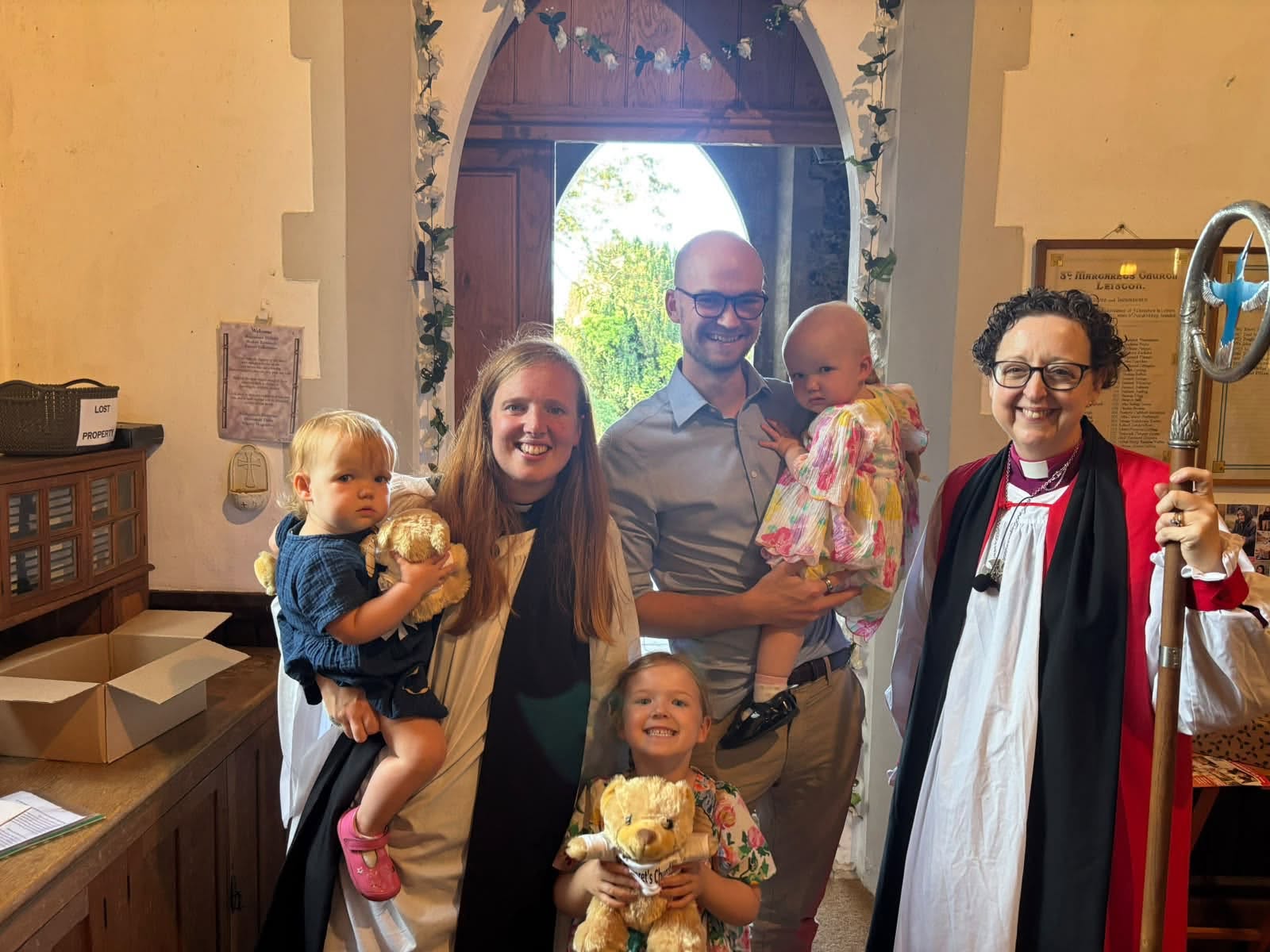
St Margaret of Antioch Leiston | 6 September 2026
The Rt Revd Dr Joanne Woolway Grenfell, Bishop of St Edmundsbury and Ipswich and a House of Lords member, said it was difficult to…
During August, many people will be looking forward to a holiday, a day trip, or simply a few days with…
Bishop Joanne writes… Earlier this month, I ate so many scones recently that I was “scone-fident” that I would soon look…